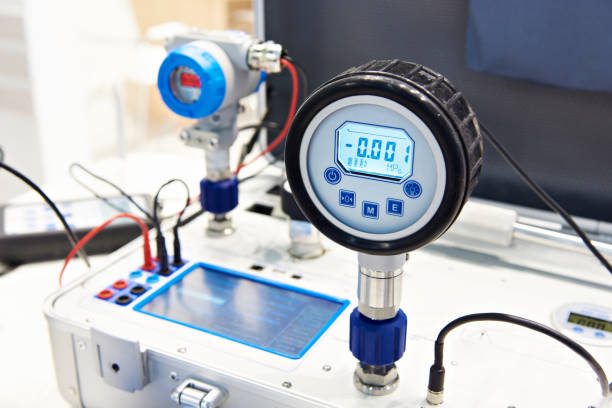

Most rotating machines give warning before they fail. Pumps, motors, fans, compressors and gearboxes often start to vibrate differently or run hotter well before they break down. Predictive maintenance means noticing those signs early and planning the repair before the failure.
Three ways to maintain equipment
Maintenance teams broadly choose between three approaches:
- Run to failure: repair a machine only when it breaks. This suits low-cost, non-critical equipment, but for anything important it means unplanned stops and often more damage.
- Preventive maintenance: service equipment at fixed intervals. Parts are sometimes replaced while they still have plenty of life left, and faults that develop between services can still be missed.
- Predictive maintenance: measure the condition of the equipment and act when the data shows a problem developing, so that work is planned around what each machine actually needs.
What vibration reveals
Every rotating machine has its own vibration signature. When something starts to go wrong, the signature changes. Vibration monitoring detects early signs of mechanical failure, such as imbalance, misalignment or bearing wear, so maintenance can be done in time and costly breakdowns prevented.
Analysts look at how strongly a machine vibrates, at which frequencies and how that changes over time. Different faults tend to show up at different frequencies, so vibration analysis can often indicate not only that something is wrong but also what is likely to be wrong.
Start with a good set-up
Many vibration problems begin at installation. Proper set-up and alignment of mechanical systems give optimal load distribution, lower energy consumption and longer equipment life. Precisely aligned shafts and couplings, a level, rigid base and well-balanced rotating parts remove many causes of vibration before monitoring even begins.
SourceGraph’s automation, mechanical and vibration system set-up work covers everything from the design and installation of automated machinery to precision alignment and vibration analysis.
Where AI comes in
Condition data piles up quickly. Each sensor produces a continuous stream of readings, and a large site has many machines to watch. AI helps by separating the signals that matter from the noise. By integrating sensors with AI models, SourceGraph monitors vibration, temperature and other operational data to predict equipment failures before they occur.
Machine-learning models learn what normal looks like for each machine under its usual operating conditions and flag readings that depart from it. Combining vibration with temperature and other operating data makes alerts more dependable, because a change that appears in several measurements at once is more likely to be real. The aim is not to replace engineers but to point them to the machines that need attention, with time to plan the work.
Getting started
Predictive maintenance does not have to cover a whole site at once. A practical first step is to list the machines whose failure would stop production or create a safety risk, make sure they are properly installed and aligned, and start monitoring those. As data builds up, the models improve and monitoring can be extended to more equipment.
How SourceGraph can help
SourceGraph specialises in the set-up and integration of automation systems, mechanical components and vibration monitoring technologies. AI runs through our work, from predictive maintenance to software development: on the software side, we deploy AI-assisted development environments where AI agents work alongside human developers. Send us a message to request a free consultation.
Automation, mechanical and vibration system set-up
Set-up and integration of automation systems, mechanical components and vibration monitoring technologies.